

Samuellimabraz Open Sources Quantum Assistant
Samuellimabraz has open-sourced Quantum Assistant, a project specializing vision-language models for quantum computing with Qiskit, aiming to bridge the gap between visual data and code generation. The release includes the first public multimodal dataset for quantum computing, containing 8,366 samples with 45% featuring images across function completion, code generation, and Q&A tasks.
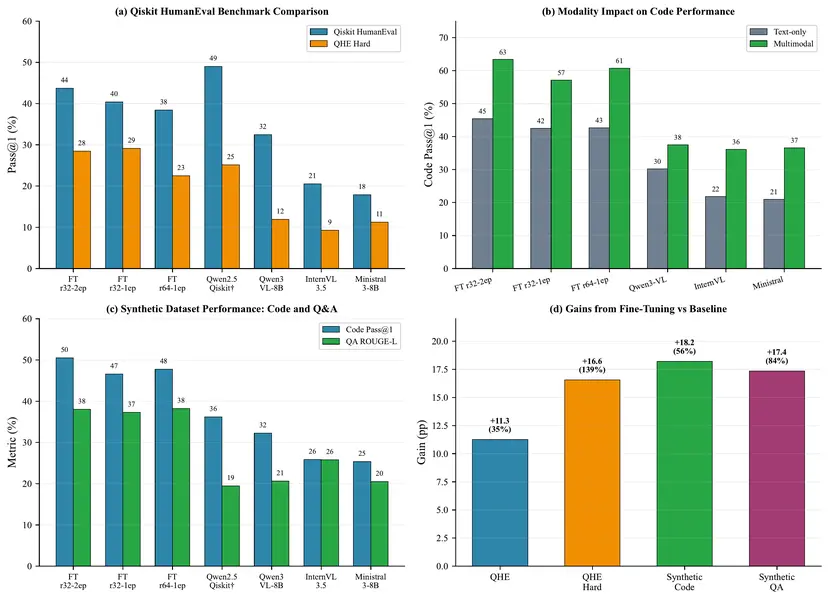
By fine-tuning Qwen3-VL-8B using LoRA (rsLoRA r=32), the developer achieved a performance increase on Qiskit HumanEval from 32.45% to 43.71%, an improvement of 11 percentage points. This approach allows the model to process visual inputs that previous tools could not handle.
Core Features & Technical Capabilities
- Automated synthetic data pipeline extracting content from Qiskit papers.
- Vision-language model transcription of circuit diagrams, Bloch spheres, and histograms.
- Automated code validation through integrated unit tests.
- Specialized fine-tuning for visual parameter inference and circuit topology extraction.
- Interactive demo featuring a chat interface and code challenges.
- Full open-source release under the Apache 2.0 license.
Benchmark Results & Performance Metrics
The technical evaluation demonstrates substantial gains in processing visual information compared to text-only inputs. Benchmarks show the fine-tuned model achieving 63.39% Pass@1 on visual samples, a significant leap from its text-only performance.
In comparison to baseline models like Qwen3-VL-8B-Instruct, which scored 32.45% on Qiskit HumanEval, the specialized Quantum Assistant model reached 43.71%. Results also indicate a 17.9 percentage point improvement on multimodal samples versus text-only samples within the synthetic dataset. The system proved capable of extracting circuit topology from diagrams and inferring parameters from visual annotations.
Expert Analysis & Developer Insights
The development addresses a specific limitation in current quantum computing tools.
'Existing quantum code assistants (like IBM's Qiskit Code Assistant Qiskit ) only process text, ignoring visual representations—circuit diagrams, Bloch spheres, histograms,'
Samuellimabraz explains that the model achieves 63.39% Pass@1 on visual samples because
'it learned to extract circuit topology from diagrams and infer parameters from visual annotations.'
The project utilized ms-swift, transformers, vLLM, PEFT, and Qiskit to build the pipeline. This modular design allows the synthetic data generation process to be adapted for other technical domains beyond quantum computing.