



Meituan LongCat-Next Unifies Vision and Audio Seamlessly
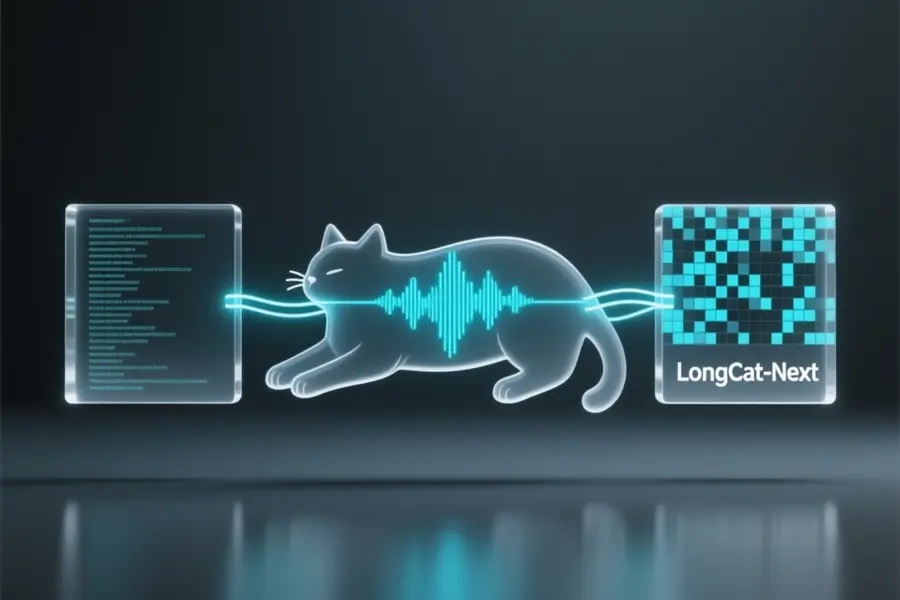
LongCat-Next is a native multimodal model capable of processing text, images, and audio within a single system. It treats visual and audio signals as language tokens, allowing the model to understand and generate content across different formats simultaneously.
Developed by the Meituan LongCat Team who also brought us Longcat-Flash-Prover, this project aims to solve the fragmentation often found in multimodal systems. Instead of using separate specialized components for different tasks, this model provides a unified approach to seeing, creating, and speaking.
Model Size: 150GB+ & VRAM GPU: Varies
A unified approach to multimodal tasks
- Processes text, vision, and audio under a single framework.
- Generates images with high-quality text rendering inside the visuals.
- Supports low-latency voice conversation and customizable voice cloning.
- Handles images at native resolutions without fixed constraints.
- Integrates understanding and generation tasks without performance conflicts.
- Released under the permissive MIT license.
Developers building complex interactive applications can use this tool to create agents that see, hear, and speak naturally. It simplifies development pipelines by removing the need to stitch together separate models for vision, audio, and text tasks.
Hardware requirements and development
The team designed this model to treat vision and audio as direct extensions of language, moving away from complex, modality-specific designs. They have open-sourced the model weights and tokenizers to encourage further research.
'We open-source the LongCat-Next and its tokenizers, hoping to foster further research and development in the community,'
said the team in the project description.
Running the model requires significant computational resources. The official documentation recommends using at least three GPUs with 80GB of VRAM each, such as H100s or A100s, for inference. Users will also need a specific environment setup including Python 3.10 and recent versions of PyTorch and Transformers.
You can download the model weights on Hugging Face or review the source code on GitHub. The full research details are available in the technical paper.