


Emo’s Topic-Specialized Experts Cut Memory by 75% With 1% Loss
Emo is a new mixture-of-experts language model designed so groups of experts naturally specialize in specific topics during training, rather than requiring human labeling. The main release from the Allen Institute for AI (AI2) is a 1-billion active parameter model spread across 14 billion total parameters, trained on 1 trillion tokens. This approach lets users run only a fraction of the model for a given task while keeping most of the performance, which saves significant memory.
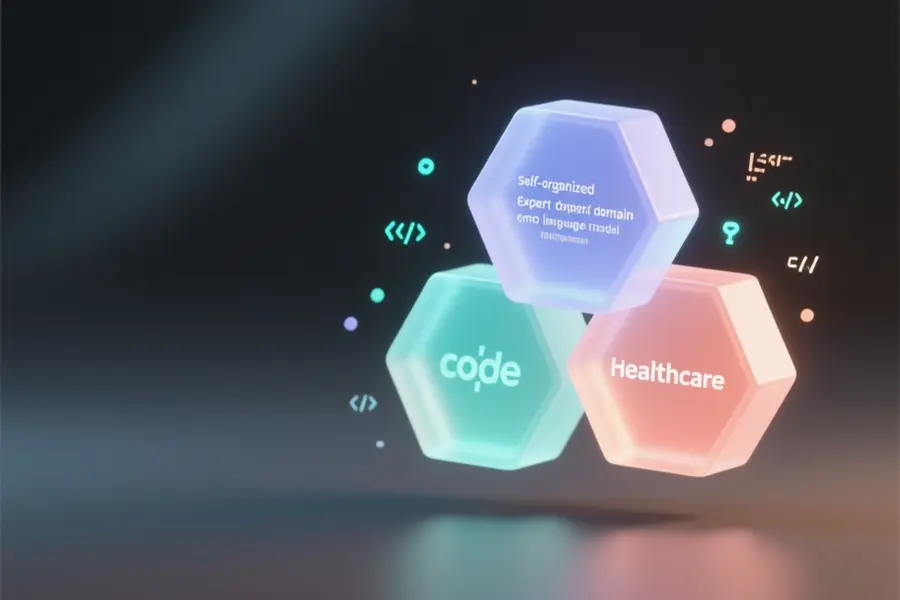
The team behind EMO introduced a simple document-level constraint during pretraining. All tokens within the same document must pick experts from a limited, shared pool, while different documents can use entirely different pools. Over time, this causes coherent expert groupings to emerge around domains like math, code, or healthcare without any manual sorting.
Experts that specialize without labels
Key Features
- 14B total parameters with only 1B active.
- Document-level routing avoids surface-pattern expert selection.
- Experts self-organize into topics like math or code.
- Using just 25% of experts loses only 1% performance.
- Matches standard MoE when run as full model.
- Includes smaller 130B-token and memory-matched baselines.
- Supports Hugging Face transformers with trust_remote_code.
Professionals working on consumer GPUs and privacy-conscious users can gain the most from this design. Instead of loading a dense model that requires full memory, they can activate only the expert subset relevant to their current work. Small agencies running local servers could also serve different tasks by swapping lightweight expert groups without reloading massive files.
What the researchers found
The paper shows standard mixture-of-experts models fall apart when forced to use only a subset of experts, suffering severe performance drops that prevent real-world use. EMO changes this by proving modularity can emerge naturally from document boundaries alone, without any domain annotations. The team also tested whether this behavior could be added after pretraining by annealing a standard MoE under their objective, which they document as a separate ablation study.
"We introduce EMO, an MoE designed for modularity—the independent use and composition of expert subsets—without requiring human-defined priors." — Source: arXiv paper
Project Links