Cosmos3-Nano Conjures Video, Audio, and Robot Commands from Any Input
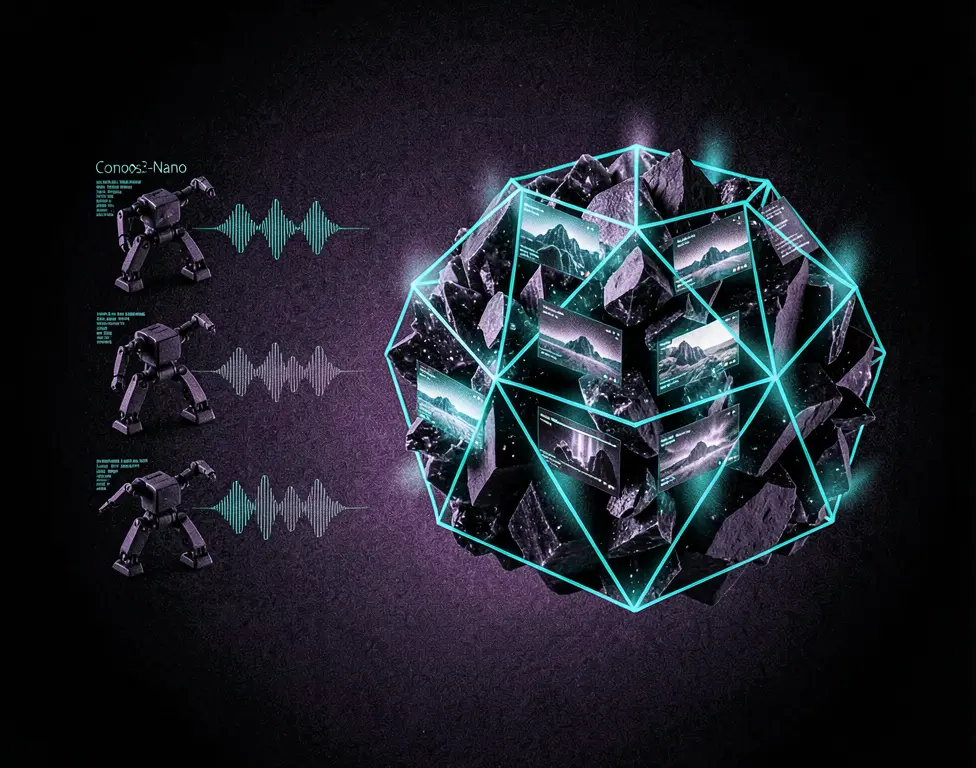
Nvidia has released Cosmos3-Nano, a 16-billion-parameter omnimodal model that turns text, images, video, audio, or action data into dynamic video with synced sound, reasoning text, or robot movement commands. The model is part of the Cosmos 3 platform and can handle a mix of inputs at once, generating coherent outputs across multiple modalities. It is now available on Hugging Face under a license that allows both commercial and non-commercial use.
Built by NVIDIA for Physical AI applications, Cosmos3-Nano targets robotics, autonomous driving, and smart space environments. The company released it as an open, locally deployable foundation model that developers can run on their own NVIDIA GPU hardware. This gives privacy-conscious teams and serious hobbyists a way to prototype and simulate without sending data off-device.
Omnimodal generation and action reasoning
Key Features
- Generates video with synced stereo audio.
- Accepts text, images, video, and action inputs.
- Uses 16B Mixture-of-Transformers architecture.
- Predicts robot and autonomous vehicle actions.
- Outputs reasoning text with chain-of-thought.
- Processes up to 256K-token context lengths.
- Runs on NVIDIA Ampere, Hopper, and Blackwell GPUs.
- Commercially usable under a permissive license.
This tool fits teams and hobbyists who build or experiment with AI-driven robotics, self-driving logic, or synthetic data generation. Because it runs locally on pro-consumer or server-grade NVIDIA cards, users can keep sensitive video and action data off the cloud. Its unified handling of video, audio, and motion makes it a flexible backbone for prototyping physical world interactions.
Developer notes and known limitations
NVIDIA cautions that Cosmos3-Nano is not a physically accurate simulator; it can produce objects that flicker or morph, unrealistic collisions, and action drift in longer sequences. The model was tested only in BF16 precision on Linux systems and requires an NVIDIA GPU with enough memory for the 16B parameter footprint. It should not be used as a safety-certified decision-maker without adding external validation and domain-specific guardrails.
"Cosmos3 outputs should not be treated as physically accurate simulation, reliable ground-truth reasoning, or safety-certified decision making." — Source: Hugging Face model card
Project Links